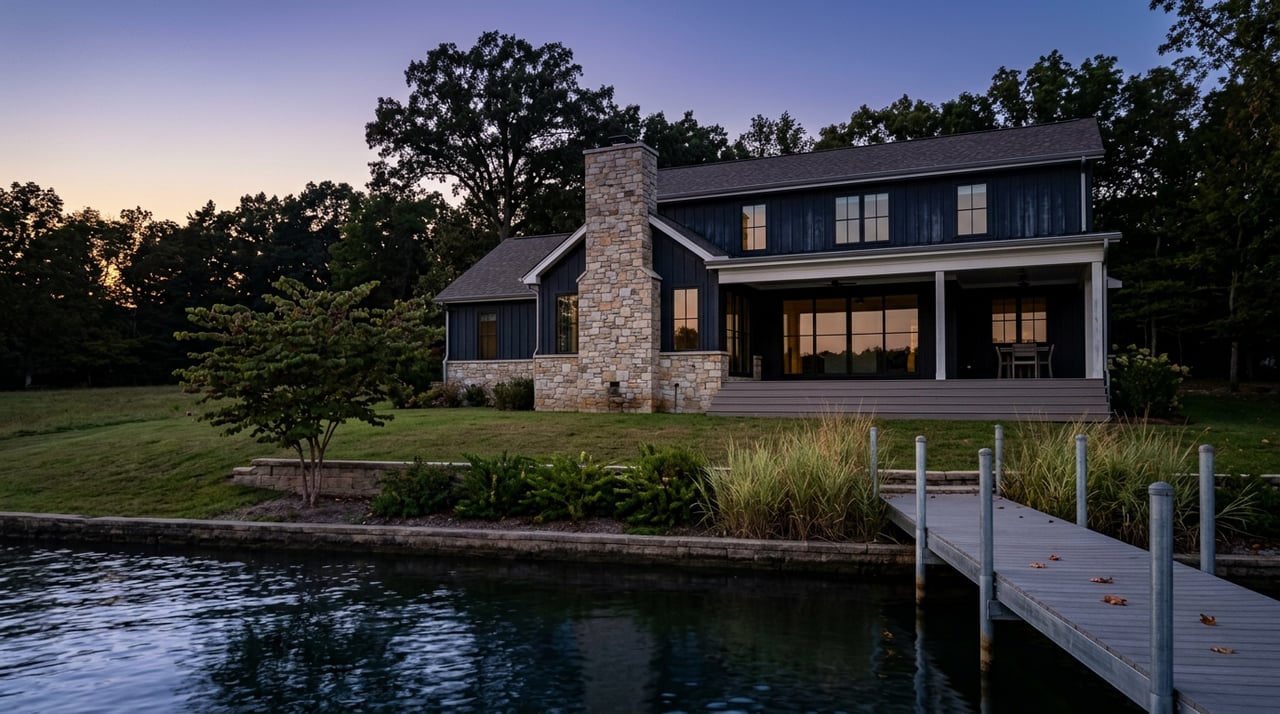
Ask a buyer touring a home on the Gravois Arm whether the property is on septic or sewer, and most will treat the answer as a fixed fact, something to check off a list next to square footage and dock depth. In this particular stretch of the lake right now, that assumption is wrong. A specific state-funded construction project is actively moving through Laurie and Gravois Mills, converting private septic systems to central sewer one subdivision at a time, and a home's status can change mid-listing. The question worth asking isn't septic or sewer. It's where does this parcel sit in the queue, and what does that do to a closing timeline.
The Project Nobody's Listing Mentions
The Missouri Department of Natural Resources awarded $6.37 million in financial assistance to the Gravois Arm Sewer District on September 26, 2025, for what the district calls its Phase VI Collection System Expansion. The full project is estimated at $6.8 million, funded through a $3.37 million loan and a $3 million grant from the Clean Water State Revolving Fund, and it's designed to extend wastewater collection to roughly 350 homes currently running on private septic along the lake. State officials estimate the funding structure will save district ratepayers about $3 million in principal and another $1.6 million in interest over the loan's 20-year term, according to the department's own announcement.
The district's own construction bid documents describe the physical scope: about 123,660 linear feet of small diameter main and electrical conduit, four large lift stations, and 351 individual sewer service connections. Sealed bids opened June 10, 2025, through Alpha Engineering and Surveying in Eldon, and the district's board, chaired by Ryan Beattie, indicated the contractor, identified in board updates as Brulez, was anticipating a construction start in late November or early December 2025. The district's own estimate for full build-out runs about 12 months once work begins, with the DNR's project timeline pointing to completion by March 2027.
None of that appears on a typical MLS sheet. A buyer or seller who only checks the box for "septic" or "sewer" is missing the part of the story that actually determines how the sale plays out.
The District Doesn't Move All at Once
Phase VI isn't the district's first expansion, and its history explains why a septic-to-sewer conversion here is never a single flip of a switch. The Gravois Arm Sewer District's first publicly financed project served the town of Gravois Mills itself, completed in March 2007 with $1.6 million from USDA Rural Development and bringing the district to about 175 customers. Phase II added a regional wastewater treatment plant and roughly 53 more customers, funded in part by a $1 million grant from the Missouri Department of Natural Resources.
Phase III, running from 2011 to 2013, was the largest single expansion to date at $8.2 million, adding somewhere between 600 and 700 customers across named areas including Pistol Point, Tonys Point, Millstone Estates, Dunwanderin, Triangle Cove, Morning Sun, Eastwood Road, Towering Oaks Road, Cedar Point, Sheldon Point, Old Hickory, and Lake Road, along with a pressure line running along Highway 5 past Coconuts Restaurant and Serenity Cove. Phase IV followed in 2018 and 2019, adding about 160 homes along Grey Eagle Road, Worley Road, Golden Oaks, Millers Rest, and a portion of Moffitt Point for $2.3 million. Phase V, with construction let in early 2020, targeted roughly 143 connections on the remaining side of Pelican Point, Morgan Hills, and the rest of Moffitt Point, drawing on $3.3 million in state Clean Water funds.
| Phase | Timeline | Connections Added | Project Cost |
|---|---|---|---|
| I | Completed 2007 | ~175 customers | $1.6M (USDA/RD) |
| II | Following Phase I | +53 customers | $4.2M+ (incl. $1M MODNR grant) |
| III | 2011 to 2013 | 600 to 700 customers | $8.2M (incl. $1M EPA grant) |
| IV | July 2018 to early 2019 | ~160 homes | $2.3M (incl. $672K grant) |
| V | Contract let early 2020 | ~143 connections | $3.3M (state Clean Water funds) |
| VI | Bids opened June 2025, targeting completion March 2027 | ~350 homes | $6.8M ($3.37M loan + $3M grant) |
The pattern matters more than any single number in that table. This district works in geographic waves, each one a multi-million dollar, multi-year undertaking covering a specific set of roads and coves. A house two doors down from a home already on sewer might sit on a septic system that won't see a connection date for years, simply because it falls outside the current phase boundary. The district has also run smaller targeted extensions between the numbered phases, including a project near Navajo Beach Lane and Navajo Beach Drive southeast of Gravois Mills that tied about 20 homes and one restaurant and tavern into the system, removing an estimated 23 leaking residential septic systems next to the shoreline. Coverage expands in pockets, not all at once.
The Old Tank Is Still Your Problem
For a homeowner whose property does fall inside an active phase, the district's own FAQ spells out what actually happens at the moment of connection. The switch from septic to sewer is completed the same day, but the existing tank remains the homeowner's responsibility afterward. The district's guidance recommends filling metal tanks with pea gravel to prevent a future cave-in, and lateral fields can be left in the ground rather than excavated. The construction itself requires an easement, typically five feet on either side of the new service line, the electrical connection to the grinder station, and a similar radius around the grinder location itself.
For a seller, this creates a documentation question that a straightforward septic sale never raises. If a previous owner connected to GASD sewer years ago, was the old tank properly abandoned, and is there any record of it? If the property hasn't connected yet, is the seller aware of the district's current phase boundary and timeline for that specific address? A buyer's home inspector checking a septic system that may be replaced by a district connection within the next year or two is evaluating something different from either a stable long-term septic system or an already-sewered home, and the negotiation logic around repairs shifts accordingly. Spending money to fix a drain field on a system slated for replacement is a different conversation than the same repair on a system with no planned connection in sight.
Where This Meets the Closing Table
According to iBuyer.com, Missouri law requires sellers of most one- and two-family residential properties to complete a Seller's Property Disclosure Statement, and that disclosure is where known sewer and septic issues are supposed to surface. The statement has to be delivered to the buyer before a purchase contract is signed, or within whatever window the contract specifies, and late delivery can give a buyer the right to terminate. That statutory requirement doesn't change because a home happens to sit inside a sewer district's active expansion zone. If anything, it raises the bar for what a seller in this corridor should actually know before listing.
The district's own board updates from earlier in this process are a useful reminder that these timelines aren't fixed the moment funding is announced. In one update posted before bids opened, the board noted that Phase VI funding had been obligated but that a complete award would come a month or two after bid opening, and that the project could not yet go out for bids at that point. The same update reiterated the district's standing advice to homeowners still on aging septic systems: keep maintaining them until the sewer connection actually arrives, because deterioration doesn't pause for construction schedules. A buyer relying on a general estimate of when a neighborhood will connect is relying on a moving target. The more reliable move is contacting the district's office directly, at 28982 Harbour Road in Gravois Mills, to ask where a specific parcel falls in the current build sequence.
A Few Direct Questions
What happens to my septic tank once GASD connects my property? The switchover happens the same day, but the tank itself remains the homeowner's responsibility. The district recommends filling metal tanks with pea gravel to prevent a cave-in, and lateral fields can typically stay in place rather than being removed.
Am I required to disclose septic issues if I sell before my home connects to sewer? Missouri's Seller's Property Disclosure Statement covers known sewer and septic problems, and it must be delivered to the buyer before the purchase contract is signed or within the timeframe the contract specifies.
How do I find out if my specific address is in the current Phase VI construction area? The district's board meets monthly and posts phase updates on its own site, but the most direct answer comes from calling the district office in Gravois Mills and asking about your parcel specifically, since coverage boundaries shift phase by phase.
Does an already-sewered home in this district still need septic paperwork at resale? Once a property is connected, the relevant documentation shifts from septic records to confirming the sewer account transfer and any easement agreements tied to the original installation, rather than septic inspection history.
If you're weighing a purchase or a sale anywhere along the Gravois Arm and want a clear read on where a specific property sits in this process, the team at Susan Ellis Real Estate Group works this stretch of the lake daily and can help you sort the timeline questions before they become closing-day surprises.
This article is general information, not legal, tax or financial advice. Consult a qualified professional about your situation.